Arm Chair vs Side Chair at the Dining Table: Which Is Better? (October 2026)
Choose an arm chair for supported, relaxed seating and a side chair when you need more seats in less space. The right arm chair vs side chair choice depends on how you use the table and how much room each seat has.
On this page (7 sections)
Choose an arm chair for supported, relaxed seating and a side chair when you need more seats in less space. The right arm chair vs side chair choice depends on how you use the table and how much room each seat has.
An arm chair has rests on both sides of the seat. A side chair is usually armless, so it can slide closer to the table and often takes less width in a dining arrangement.
You don't have to choose one style for every place. Arm chairs can anchor the table ends, while side chairs fill the long sides.
 Best for a warm wood look
MALOL Leather Arm Chairs with Walnut Legs, Set of 2
 Best for fitting more seats
MALOL Curved-Back Chairs with Bronze Legs, Set of 4
Arm chair vs side chair: what is the difference?
The main difference is the arms: arm chairs provide a place to rest your forearms, while side chairs leave the sides open. That changes the feel of the seat and how easily it fits beside another chair.
Armrests can make long meals feel more relaxed for people who like upper-body support. They also add width and can interfere with a table apron or prevent the chair from sliding fully underneath.
Side chairs keep the profile simpler. That can help in a narrow dining room, or when you need more seats around one table.
For a broader overview of dining seat styles, see types of dining chairs and where they work. If you're comparing the terms used for everyday table seating, side chair vs dining chair explains how the labels overlap.
Which chair works better around your table?
Choose side chairs when seat count and easy movement matter most; choose arm chairs when you have room and value arm support. Table shape, room clearance and who uses each seat all affect the best layout.
A side chair is often the practical choice for the long sides of a rectangular table. Without arms, it can be easier to push the chair in and make room for another seat.
An arm chair can suit a head-of-table position, where it has more space on either side. That placement gives the chair room to move and makes the end seat feel distinct.
When should you choose an arm chair?
Pick arm chairs if you prefer a more supported seat for meals, conversation or working at the table. Rounded, padded arms are a feature of the MALOL Leather Arm Chairs with Walnut Legs, Set of 2.
Before choosing, check that the arms can pass beneath the tabletop. The arm height for this MALOL set is 27.17 in, so compare it with the space under your table.
The Retro Faux Leather Arm Chairs, Set of 2 pair curved backs and supportive armrests with a cushioned seat. Their metal frame supports up to 300 lb per chair.
When should you choose a side chair?
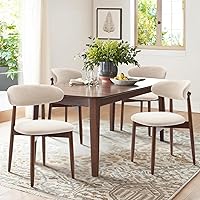
Choose a side chair when you want a clear path to the table or need to fit several seats along one side. The MALOL Curved-Back Chairs with Bronze Legs, Set of 4 are armless, with padded seats and curved backs.
Armless chairs can also be simpler for children or guests to pull out and sit down in a tight room. A curved back still offers support, though it doesn't provide a place to rest your arms.
How much space do arm chairs need?
Plan for the chair's full width and movement, including the arms, rather than measuring only the seat. A chair that fits when pushed in may still block a walkway when someone sits down.
Measure the widest point of each chair. Then map the arrangement around the table, leaving enough room to pull out a chair and pass behind it.
The arm chair's added width can reduce the number of seats that fit comfortably. The chair's shape matters too: a barrel back can spread wider than its seat.
Use the room dimensions and chair measurements together. Our guide to space between dining chairs can help you plan a layout that doesn't crowd diners, and how wide a dining room chair is covers the measurements to compare.
Will the arms fit under the table?
Measure the height from the floor to the underside of the table and compare it with the chair's arms. Also check for an apron, support rail or other obstruction beneath the tabletop.
A chair may look low enough yet stop short because its arms touch the table. That can leave the seat jutting into the room, where it blocks a walkway or another chair.
For the MALOL Leather Arm Chairs with Walnut Legs, the arm height is 27.17 in. Compare that figure with the clearance under your table, and account for any trim or supports.
If your table has a thick apron, measure to its lowest point. You can also check the chair's width and depth against the available space before deciding where to place it.
Can you mix arm chairs and side chairs?
Yes, mixing the styles can give you arm support at the ends and more flexible seating along the sides. A coordinated finish or upholstery helps the set look intentional.
Try two arm chairs at the ends of a rectangular table, with side chairs along each long edge. This layout works only if the ends have enough clearance for the wider chairs.
For a round or compact table, compare the actual chair widths and how their backs sit around its edge. Don't assume the same count will fit just because chairs are armless.
You can mix different materials while keeping one feature consistent, such as seat color, leg finish or back shape. Leave enough room for every seat to slide out without hitting a wall or another chair.
Which chair is easier to keep clean?
Choose upholstery based on the messes you expect and the care instructions for the chair. Faux leather can be wiped clean, while fabric may need a different approach.
Both arm chair sets here use faux leather upholstery. The MALOL set describes its surface as wipe-clean, and the HNY set says its faux leather can be cleaned with a damp cloth.
The armless MALOL set uses fabric upholstery. If you choose fabric, keep the care instructions nearby and address spills promptly.
Our guide to cleaning upholstered dining chairs covers routine care for fabric seats. For a material comparison, see faux leather vs fabric dining chairs.
Which dining chair should you choose?
Choose arm chairs if you want arm support and have enough clearance; choose side chairs if you need a simpler fit around the table. For a mixed layout, put arms at the ends and use armless seats along the sides.
The MALOL Leather Arm Chairs with Walnut Legs offer rounded padded arms, a curved backrest and walnut wood legs. The Retro Faux Leather Arm Chairs add a barrel shape and a metal frame rated to support up to 300 lb per chair.
For a set of 4 armless chairs, the MALOL Curved-Back Chairs with Bronze Legs have padded seats and adjustable foot pads. Compare the full chair dimensions and table clearance before settling on a layout.
Start by measuring the table, chair space and nearby walkways. Then choose the seat style that gives you enough room to sit, stand and move through the dining area.
Frequently asked questions
Are arm chairs or side chairs better for a dining table?
Arm chairs suit diners who want arm support and a more defined seat, while armless side chairs usually fit more easily around a crowded table. You can use arm chairs at the ends and side chairs along the long sides, then check clearances before choosing a set.
Do dining arm chairs fit under every table?
No. The arms may hit the apron or tabletop, even when the seat itself fits.
Measure from the floor to the underside of the table, then compare that space with the chair's arm height and allow room to slide in and sit comfortably.
Can you mix arm chairs and side chairs?
Yes. A common layout uses arm chairs at the table ends and side chairs along the sides.
Keep the finishes or upholstery related, and check that the seats have compatible heights and enough space to pull out without bumping into one another.
Are side chairs always narrower than arm chairs?
Not always, but removing arms often makes a chair easier to arrange close to its neighbors. Compare each chair's full width, including its widest points, and plan for space between seats.
A curved or wide back can still take up more room than you expect.